Lahore’s Newly-Built Road Develops Massive Sinkhole Four Months After Completion
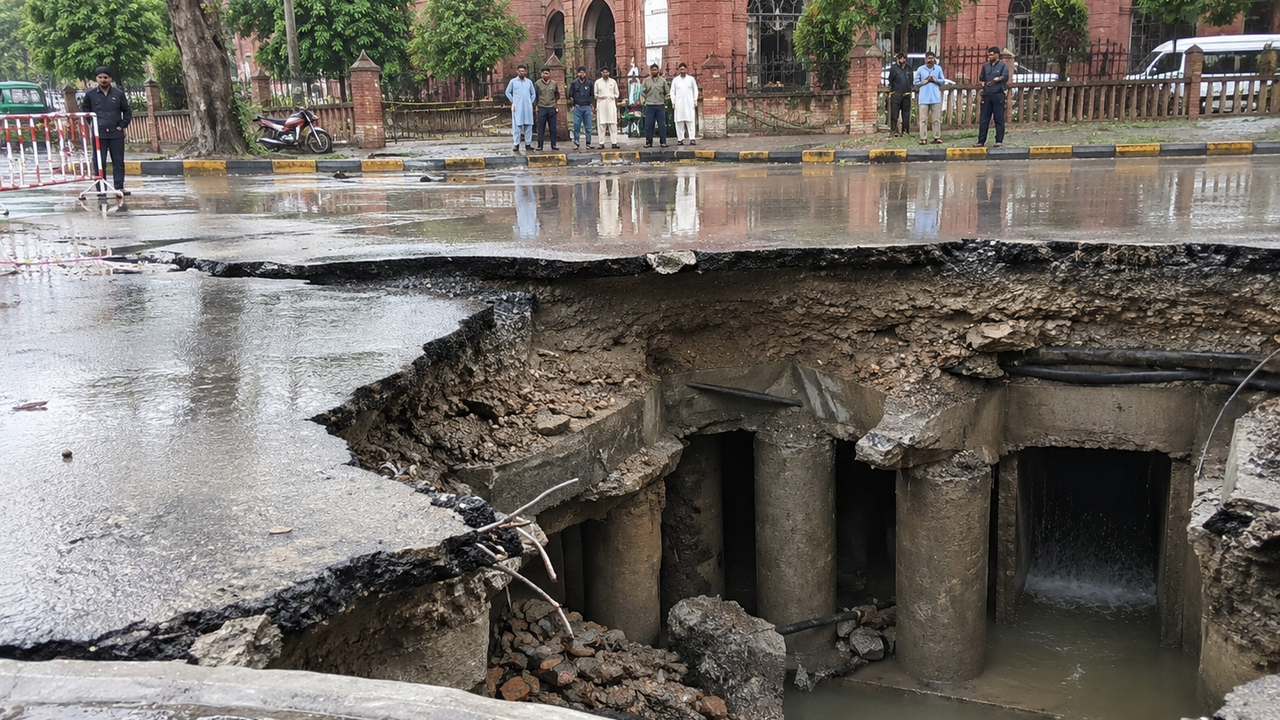
A newly constructed road in Lahore’s Johar Town has developed a large sinkhole only around four months after completion, triggering fresh public concern over urban infrastructure, underground sewerage systems and construction oversight in the provincial capital.
The affected stretch is part of the Structure Plan Road project in Johar Town. According to reports published on September 8 and 9, 2026, the approximately 1.5-kilometre road connects Shadiwal Chowk with Wapda Town Roundabout and Ghaffar Chowk. The project reportedly cost around Rs455.9 million and was completed roughly four months before the crater appeared.
No injuries were reported in the latest incident. However, the large depression has attracted attention because Johar Town has experienced several road cave-ins and sinkholes in recent years, many of them associated with underground sewerage problems.
LDA Says Road Itself Did Not Collapse
The Lahore Development Authority (LDA) has disputed the claim that the newly constructed road itself failed due to poor road construction.
LDA Director General Tahir Farooq said the crater was caused by the failure of the crown of a sewerage pipeline located approximately 20 feet underground. According to the LDA, the sewer line belongs to PIA Housing Society.
The failure apparently caused the soil supporting the surface to give way, creating a cavity beneath the road and eventually producing the visible sinkhole.
Farooq said the LDA Engineering Wing had been directed to recover approximately Rs4.1 million from PIA Housing Society for the damage. He also maintained that LDA’s Engineering Wing was not responsible for the incident.
WASA Also Rejects Responsibility
The Water and Sanitation Agency (WASA) Lahore separately issued a clarification on September 7, 2026, stating that the affected sewerage infrastructure was linked to a private housing society and did not fall under WASA Lahore’s administrative control.
According to a WASA spokesperson, a sewerage connection belonging to the private housing society had been affected at the location. The spokesperson also said that the society’s contractor had started work at the site to address the problem.
This clarification is important because the incident was initially described widely as the collapse of a newly built road. Official statements instead point toward an underground sewer failure as the immediate cause.
Johar Town Has a History of Sinkholes
The latest crater is not an isolated incident.
Johar Town, particularly Khayaban-e-Firdousi and Main Boulevard, has witnessed repeated sinkholes over the years. During heavy monsoon rainfall in July 2026, several Lahore roads developed sinkholes or cave-ins, including Johar Town Main Boulevard and Khayaban-e-Firdousi.
Previous incidents have also been linked to ruptured sewer lines and underground water seepage. Experts have explained that leaking water or sewage can wash away or weaken the soil beneath a road. When enough supporting material disappears, the asphalt above can suddenly cave in.
Questions Over Inspection and Coordination
Even if the latest Lahore Johar Town sinkhole was caused by a private sewer line rather than defective asphalt, the incident has raised questions about coordination between road construction authorities, utility agencies and private housing societies.
Residents have called for a detailed investigation to determine responsibility and assess whether underground infrastructure was properly inspected before the newly constructed road was opened.
The affected route is part of Lahore’s wider Structure Plan Road programme. The Shadiwal Chowk to Nazaria-e-Pakistan Road connection was among six major structure plan roads approved by the LDA in April 2025. Later inspections of the project also included instructions to maintain high construction standards.
For residents, the immediate priority is repairing the damaged section and ensuring that another collapse does not occur. More broadly, the incident highlights the need for road construction, sewerage infrastructure and private housing society utilities to be inspected as interconnected parts of Lahore’s urban system.
While the dramatic sinkhole appeared only months after the road’s completion, the available evidence currently supports the LDA’s explanation that an underground sewer failure—not simply the new road surface itself—caused the ground to collapse.
I’ve deliberately avoided stating that “poor construction was proven,” because no credible source I found has established that. That makes this version safer for Unfiltered Point and more defensible as an accurate news article.
(Dawn)
Reader feedback
Sign in to join the discussion.